Understanding and navigating the reputation crisis in carbon offsetting
Carbon offsetting is under growing scrutiny. We unpack why credibility collapsed, the risks behind low-quality credits and how carbon removal offers a more verifiable path forward.


You're listening to:
Kathryn has a MSc in Climate Change from the University of Copenhagen specialising in climate policy and sustainability. She has experience in science communications and impact reporting, placing her expertise in between climate change and communications. A self-proclaimed geopolitics nerd, Kathryn uses this knowledge to track and brief our community on news and updates in and around the carbon removal space.
Carbon offsetting was supposed to be a straightforward climate solution: pay to cancel out your emissions elsewhere. Instead, it has become one of the most contested areas of corporate sustainability, with investigations revealing that many carbon projects deliver a fraction of their promised benefits or nothing at all.
The fallout has left companies facing greenwashing accusations, eroded public trust in carbon markets, and created genuine confusion about what actually works. This article breaks down why the reputation crisis happened, what distinguishes credible projects from questionable ones, and how carbon removal offers a more verifiable path forward.
Why carbon offsetting has a reputation problem
The reputation crisis in carbon offsetting comes down to a simple pattern: companies buy cheap, low-quality credits to claim environmental progress while delaying real emission cuts. Evidence suggests this isn’t an edge case but in fact, it’s been the dominant buying behaviour. One peer-reviewed study that built a company-level dataset of retired credits found that companies predominantly sourced “low-quality, cheap” credits, and that 87% of the credits assessed carried a high risk of not delivering real, additional emissions reductions, with most coming from forest conservation and renewable energy project types. (Nature)
That helps explain why nature-based projects, particularly forest protection schemes, keep becoming flashpoints. Who doesn’t remember the Kariba REDD+ project in Zimbabwe, where reporting documented allegations that climate benefits were overstated and that the project became a major revenue generator for intermediaries, which in return raised hard questions about the credibility of credits used by large brands to support climate claims. (The New Yorker) The result is a market where greenwashing accusations have become widespread, and offsets are increasingly seen as a “get-out-of-jail-free card” rather than a genuine climate solution. After learning what I do for a living, someone recently gave me the now fairly common: “I feel like that’s not working anyway”.
So how did we get here? Why do most people believe the world of carbon offsetting is one big scam? Part of the problem is a knowledge gap. Many buyers lack the expertise to tell the difference between a high-quality project and one that exists mostly on paper. When a company purchases carbon credits, they're often trusting that someone else has done the due diligence. That trust has been broken repeatedly especially when scandals emerge around exactly the kinds of low-cost credits that have historically been easiest to buy at scale. (Nature)
The fallout extends beyond environmental concerns. Companies that invested in what they believed were legitimate climate solutions now face accusations of greenwashing, regulatory scrutiny, and damage to their public image. Offsetting is ultimately a strategy, accompanied by a claim, now associated with low quality credits — smoke-and-mirrors lacking robust evidence. Meanwhile, projects that actually deliver real impact struggle to attract funding as scepticism spreads across the entire market because every new controversy makes the “offset” label itself harder to defend, regardless of quality. (SWI swissinfo.ch)
What is greenwashing in carbon offsetting
Greenwashing… A term we’ve all gotten used to as part of the reputation problem. Greenwashing happens when organisations make misleading environmental claims to appear more sustainable than they actually are. In carbon markets, greenwashing typically involves purchasing cheap credits to claim "carbon neutrality" without making meaningful efforts to cut emissions at the source.
The practice shows up in several ways:
- Misleading claims: Companies overstate the impact of their purchases, suggesting they have "neutralised" their carbon footprint when the underlying credits may have little or no environmental return. The claimed impact of the offset is therefore unequal to the impact of emissions.
- Lack of verification: Buying credits without independent quality assessment or proper due diligence on whether projects actually deliver what they promise. Without providing proper evidence to back a claim, they fall fall short.
- Avoidance over action: Using inexpensive credit as a substitute for the harder work of reducing emissions directly.
When consumers and investors discover that environmental claims lack substance, trust erodes not just in the offending company, but in corporate sustainability efforts more broadly. This is why greenwashing accusations have become such a significant reputational risk.
Key risks that undermine carbon market credibility
Now, it’s important to underline that the risk of greenwashing is there for a reason. Some credits are of a poor quality and there’s a number of technical problems that cause projects to fail. Understanding each one helps explain why so many credits have proven worthless and what to look for when evaluating project quality.
Additionality failures
Additionality means a project would not have happened without carbon finance. If a forest was already protected by law, or a renewable energy plant was already profitable without carbon revenue, then selling credits for that activity generates no additional climate benefit.
The challenge is proving a counterfactual—what would have happened without the project. This is inherently difficult to demonstrate, and many projects have been found to claim credit for activities that would have occurred anyway.
Permanence concerns
Permanence refers to how long carbon stays stored. A tree absorbs carbon dioxide as it grows, but if that tree burns in a wildfire or gets cut down, the stored carbon returns to the atmosphere.
This risk is particularly acute for some nature-based projects. Climate change itself increases the likelihood of fires, droughts, and pest outbreaks that can destroy carbon stores decades before their intended lifespan ends.
Leakage and displacement
Leakage occurs when emissions shift elsewhere rather than being prevented. For example, protecting one forest may simply push logging activity to a neighbouring area that lacks protection.
This displacement effect can negate much or all of a project's claimed benefit. Accounting for leakage requires monitoring beyond project boundaries—something many schemes fail to do adequately.
Baseline inflation
The baseline is the reference scenario used to calculate avoided emissions. If a project claims it prevented deforestation, the baseline represents how much forest would have been lost without intervention.
Inflated baselines lead to credits being issued for reductions that never actually occurred. Some projects have been found to exaggerate deforestation threats dramatically, generating millions of credits for "avoided" emissions that were never going to happen in the first place.
How to identify high-quality carbon projects
Ready to write-off carbon credits as a whole? Don’t worry, there is hope for the market’s reputation as not all carbon projects are created equal. Several criteria help distinguish credible initiatives from questionable ones.
1. Verify third-party certification
Reputable standards like Verra, Gold Standard, and Puro.earth provide independent verification of project claims. However, certification alone is not sufficient and even certified projects have been found to underperform. Look for projects that go beyond minimum certification requirements and provide detailed, transparent documentation.
2. Assess additionality evidence
Strong projects provide clear documentation showing that carbon revenue was essential to their viability. If a project would have happened anyway—through existing regulations, economic incentives, or other funding sources—the credits it generates have limited value.
3. Evaluate permanence guarantees
Check how long carbon will remain stored and what safeguards exist if storage fails. Some standards require buffer pools or insurance mechanisms to address reversal risks, providing an extra layer of protection.
4. Demand transparent monitoring data
Quality projects provide ongoing measurement, reporting, and verification (MRV). This includes regular updates on project performance, independent audits, and publicly accessible data that allows buyers to track outcomes over time.
The lack of transparent data is a root cause of the reputation crisis. When buyers cannot independently verify project outcomes, they rely on trust—trust that has been repeatedly violated by projects that overpromised and underdelivered.
Quality projects openly share their methodology and assumptions, independent verification reports, ongoing monitoring data, and clear impact metrics. This transparency allows buyers to make informed decisions rather than taking claims at face value.
Technology is improving verification capabilities. Satellite monitoring can track forest cover changes in near real-time. Sensor networks can measure soil carbon with increasing accuracy. Digital registries can provide tamper-proof records of credit issuance and retirement. Together, these advances make it harder for low-quality projects to hide behind opaque reporting.
5. Prioritise carbon removal over avoidance
Removal projects offer more certain, measurable outcomes than avoidance-based credits. While removal credits typically cost more, they carry lower risk of the additionality and permanence problems that have damaged the offset market's reputation.
Carbon offsets vs carbon removal
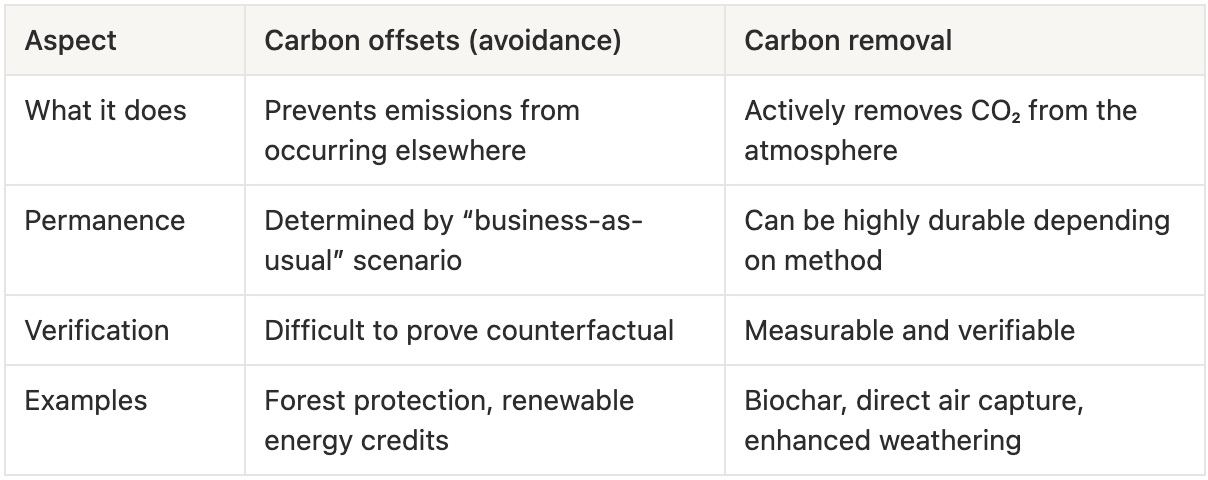
Call me biased, but I want to dive a bit further into the world of carbon removal and how it can deal with the reputation crisis. Understanding the distinction between avoiding emissions and removing carbon is essential for navigating this difficult landscape. The two approaches work differently and carry different risks.
How carbon offsets work
Traditional carbon offsetting involves companies that pay for cheap activities that prevent emissions from occurring to balance-out their own emissions, called avoidance. Protecting a forest prevents the carbon stored in trees from being released. Funding a clean cookstove project prevents emissions from traditional cooking methods.
The challenge lies in proving that the emissions would have occurred without the intervention. This is the additionality problem—and it is why avoidance-based offsets are so difficult to verify with confidence.
How carbon removal works
Carbon Dioxide Removal (CDR) takes a fundamentally different approach. Rather than preventing future emissions, CDR actively extracts CO₂ already present in the atmosphere and stores it for decades to centuries. This addresses the present impacts of climate change and prevents amplified warming due to avoidance creating reductions down the line.
Why permanence matters for climate impact
To truly offset one tonne of carbon, the carbon should be stored for the same amount of time as the emissions released. Durable carbon storage, where carbon is kept our of the atmosphere for centuries or longer, is essential to ensuring long-term climate benefit.
This is why permanence has become a central criterion for evaluating carbon credit quality for companies that plan to offset, and why many organisations are shifting their focus toward removal methods with longer storage timescales.
How companies can avoid carbon credit greenwashing
For organisations seeking to invest in carbon projects responsibly, several principles help reduce risk and build credibility.
1. Prioritise emission reductions first
Carbon credits work best as a complement to direct decarbonisation efforts, not a substitute. Emerging regulations and voluntary frameworks increasingly require companies to demonstrate internal emission reductions before claiming offset benefits. This "reduce first, then offset" approach aligns with scientific guidance on effective climate action.
2. Choose verified carbon removal projects
Investing in CDR rather than avoidance offsets reduces reputational risk and delivers more certain impact. While removal credits typically cost more per tonne, they provide stronger evidence of genuine climate benefit and face fewer of the verification challenges that have plagued traditional offsets.
3. Use independent project assessment
Working with platforms that conduct rigorous scientific evaluation of projects helps identify quality opportunities. Look for partners who assess projects against multiple criteria—not just certification status, but also additionality evidence, permanence guarantees, and ongoing monitoring practices.
4. Communicate climate claims accurately
Avoid over-claiming. Be specific about what offsets achieve versus what internal reductions achieve. Transparency about methodology and limitations builds credibility rather than undermining it. Companies that communicate honestly about their climate strategy—including its limitations—tend to fare better when scrutiny increases.
How science-backed carbon removal rebuilds market trust
The reputation crisis, while damaging, has also driven positive change. Rigorous scientific evaluation, transparent data, and measurable outcomes are becoming the new standard for credible climate action.
High-quality CDR projects demonstrate that carbon markets can deliver genuine impact when built on solid foundations. By focusing on verifiable removal rather than uncertain avoidance, these initiatives offer a path forward for organisations committed to meaningful climate action.
For organisations exploring credible carbon removal options, get in touch to learn about high-integrity solutions backed by rigorous scientific assessment.
FAQs about carbon offset reputation and quality
What is the difference between carbon offsets and carbon removal?
Carbon offsetting is a strategy where companies claim that they have counterbalanced their impact by investing in carbon credits. Typically, this means they pay for activities that prevent emissions from occurring elsewhere, called avoidance. Carbon removal, on the other hand, actively extracts CO₂ from the atmosphere and stores it durably. Removal provides more measurable, verifiable outcomes because it does not rely on proving what would have happened without the project.
Which carbon credit certification standards are most rigorous?
Standards like Puro.earth focus specifically on carbon removal with strict permanence requirements. Verra and Gold Standard cover a broader range of project types, with quality varying significantly across their portfolios. Certification is a useful starting point, but independent assessment of individual projects remains important.
How are regulations on carbon offsetting claims changing?
Regulators are increasingly scrutinising environmental claims, with new guidelines requiring companies to substantiate offset-based statements. The European Union, for example, has proposed restrictions on "carbon neutral" claims that rely solely on cheap credits. This regulatory pressure is pushing companies toward more credible approaches.
Can carbon removal projects also fail like traditional offsets?
Yes, though the risks differ. Engineered removal methods like biochar and direct air capture offer more durable storage and clearer proof of additionality than avoidance-based offsets, but all projects require proper verification and ongoing monitoring. No approach is entirely risk-free, which is why due diligence remains essential.
How does technology improve carbon removal verification?
Advanced MRV technologies—including satellite imagery, sensor networks, and digital registries—enable more accurate, transparent tracking of carbon storage and project performance over time. These tools make it easier to verify claims and harder for low-quality projects to overstate their impact.
Kathryn has a MSc in Climate Change from the University of Copenhagen specialising in climate policy and sustainability. She has experience in science communications and impact reporting, placing her expertise in between climate change and communications. A self-proclaimed geopolitics nerd, Kathryn uses this knowledge to track and brief our community on news and updates in and around the carbon removal space.
Discover the news shaping the future of carbon removal.

Navigating CSRD and Carbon Removal
Heading 1
Heading 2
Heading 3
Heading 4
Heading 5
Heading 6
Lorem ipsum dolor sit amet, consectetur adipiscing elit, sed do eiusmod tempor incididunt ut labore et dolore magna aliqua. Ut enim ad minim veniam, quis nostrud exercitation ullamco laboris nisi ut aliquip ex ea commodo consequat. Duis aute irure dolor in reprehenderit in voluptate velit esse cillum dolore eu fugiat nulla pariatur.
Block quote
Ordered list
- Item 1
- Item 2
- Item 3
Unordered list
- Item A
- Item B
- Item C
Bold text
Emphasis
Superscript
Subscript
.webp)
Avoidance vs removal: what's the difference?
Heading 1
Heading 2
Heading 3
Heading 4
Heading 5
Heading 6
Lorem ipsum dolor sit amet, consectetur adipiscing elit, sed do eiusmod tempor incididunt ut labore et dolore magna aliqua. Ut enim ad minim veniam, quis nostrud exercitation ullamco laboris nisi ut aliquip ex ea commodo consequat. Duis aute irure dolor in reprehenderit in voluptate velit esse cillum dolore eu fugiat nulla pariatur.
Block quote
Ordered list
- Item 1
- Item 2
- Item 3
Unordered list
- Item A
- Item B
- Item C
Bold text
Emphasis
Superscript
Subscript
Sign up for Klimate Insights
Every second month we'll send you an update on all things Klimate, carbon removal, and the most important emerging news and policy.
Talk to a carbon removal strategist
Finding the right way to remove your CO₂ emissions can seem overwhelming. Our team is here to help. Book a meeting to walk through how our solution might fit your needs.