Our industry-leading due diligence framework ensures you to stay ahead of the curve and align with science.
We work with only the best projects rather than prioritising quantity, constantly raising our standards to ensure projects meet high expectations. This allows us to know the projects inside-out and better match projects with clients wants and needs.
Our assessment model
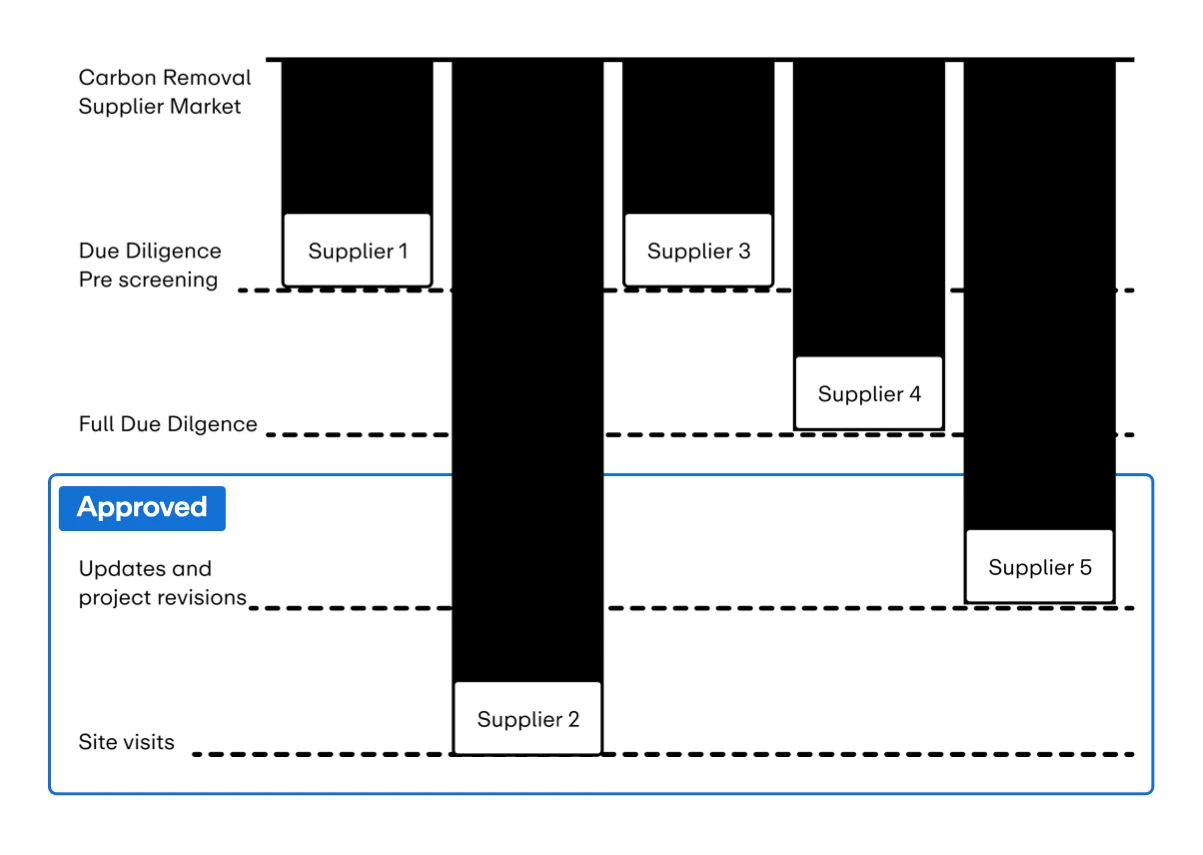
Every project moves through the same stages, from a first look to deep evaluation and ongoing review.
Pre-screening: A streamlined first look that gives us a quick overview, flags early risks, and sharpens our read on the market.
Full due diligence: A rigorous, structured evaluation covering climate impact, permanence, co-benefits, and project risk.
Updates and revisions: We refresh our due diligence every year. Active projects have to meet the current standards, and we assess them against leading frameworks.
Site visits: For early-stage technologies and key partners, we visit in person. It deepens the evaluation and builds stronger relationships.
A claim without evidence is not good enough
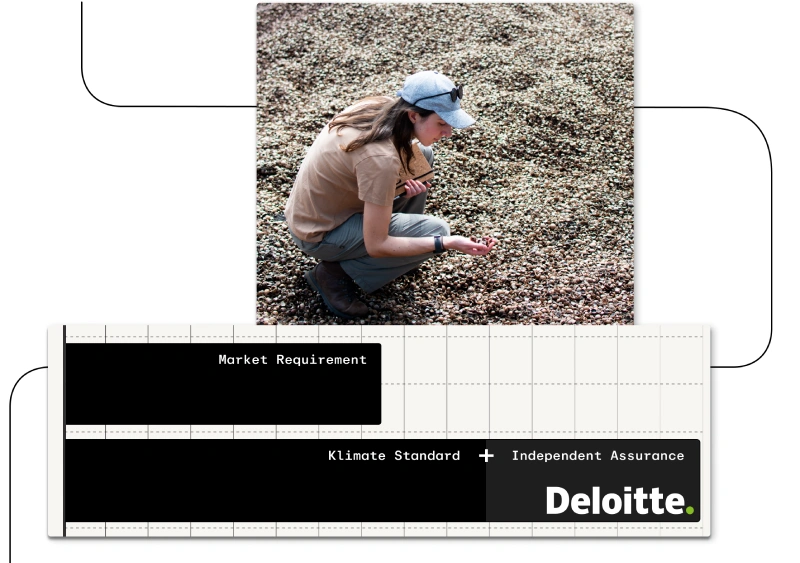
Our due diligence is independently assured by Deloitte, not because the market requires it, but as a deliberate choice to hold ourselves to a higher standard. This gives clients greater confidence that their carbon removal strategy will stand up to scrutiny.
Transparency built in
We believe credibility starts with openness. That’s why all due diligence data on individual projects is available directly in the Klimate platform giving you clear insight into risks, assumptions, and performance before and after you invest.

Human-led due diligence built for credibility
Our comprehensive due diligence framework is built and applied by real experts, providing transparent insights into project quality and risk. All projects are vetted across 4 main areas allowing us to assess all projects against the same parameters and compare the performance of different methods.
Climate impact
Klimate evaluates the permanence, rapidity, additionality, and effectiveness of carbon removal projects to determine the impact they have on climate change.
A carbon removal project is deemed additional if it creates an impact that would not have otherwise occurred in the absence of the project implementation. Additionality ensures that CDR takes place on top of emissions reductions, so that current emission scenarios cannot continue.
This category looks into the project’s operational emissions and the intensity ratio of resources needed by the carbon removal project as life cycle analyses. This ratio should be as low as possible.
Carbon removal projects combat climate change by removing atmospheric CO₂ , storing it in reservoirs, and preventing it from being re-emitted. The more permanent a removal is, and the lower the risk of reversal, the longer it keeps carbon locked away in reservoirs. Furthermore, different methods sequester carbon over a range of timescales. Rapidity measures how quickly carbon can be stored, which is crucial as climate change amplifies global warming over time.

Co-benefits
To address potential issues with carbon tunnel vision, we go beyond by evaluating the social and environmental benefits these projects generate, such as native biodiversity, soil health, or community well-being.
There are many synergies between projects and many aspects of the environment, such as, biodiversity, ecosystem habitat, resource quality, and climate resilience. However, strong protections against environmental harms are essential for a high-quality project to consider.
Beyond carbon, socially positive impacts can include job creation, increased welfare, or capacity building for community well-being. However, there are social harms such as displacement that must be safeguarded against.
Acknowledging that climate change needs to be addressed beyond carbon removal, the projects are assessed by its contribution and synergies towards the Sustainable Development goals.

Integrity
Klimate analyses the carbon accounting, certification standards, and verification procedures of carbon removal projects to ensure they are sound and credible. We hold projects to these high standards to help drive the overall integrity of the market.
Different national and international standards exist across methodologies beyond our own and those conducted internally by projects. These bodies have well-defined processes which verify and audit projects for its traceability, methodologies, and compliance. Thus, adding another important layer of checks and balances.
Different types of projects and technologies have different ways of issuing, delivering, and contracting credits. These various differences are also often reflected in the credit’s price. For example, ex-ante credits are based on a predicted future removal and involve higher risk, while ex-post credits are based on verified removals that have already occurred.
This is the continual measurement of progress towards the project’s benefits. This includes the carbon being removed, associated co-benefits, and the project’s impact on the environment. It ensures the quality of integrity associated with the impact of investment.

Scope and Implementation
We analyse the potential benefits and risks of the carbon removal projects and technologies to future-proof your investments.
Critical to our common climate goals is scaling carbon removal. Thus, it is important to analyse the scale and scope, as well as a project’s ability and limits to growth.
Knowing the project’s risks and its associated mitigation measures that could affect its operations is vital to ensuring the safety and reliability of the carbon storage.
Ensuring best practice across the carbon removal market is essential to reaching our future climate goals. We analyse these governance structures, such as procedures, policies, and local community engagement.

The methods we work with
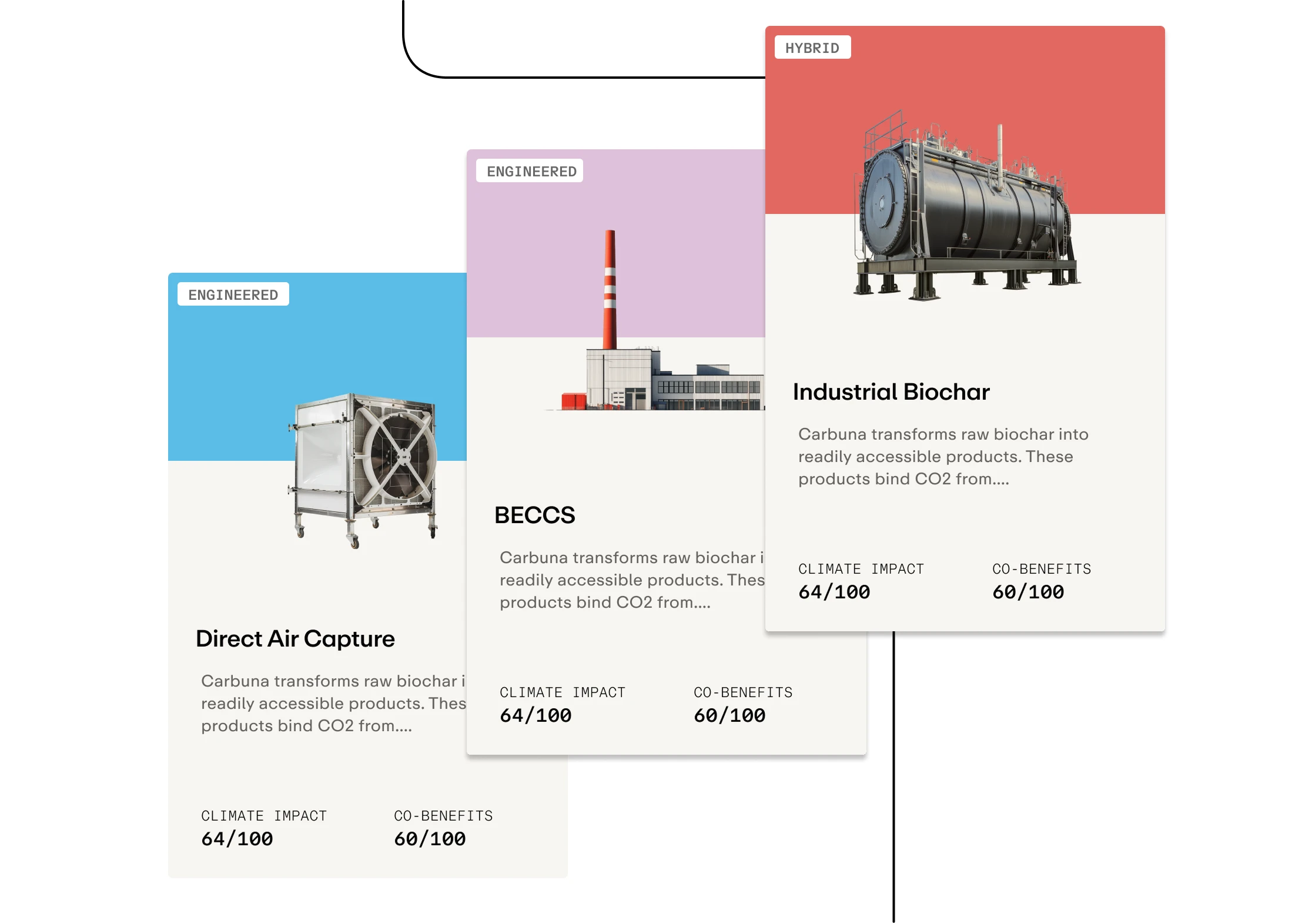
We work selectively across the CDR spectrum, focusing on methods with high technology readiness and where buyers have already purchased volumes, many of which have been fully or partially delivered.
Choosing this way lowers risk for our clients by design. At the same time, it helps nascent technology move from pilot facilities to full-scale projects.
Get to know the science that shapes our business.
Our approach is guided by leading authorities and scientific experts to ensure investment in high quality, high integrity, and additional carbon removal projects. This is the path to a net zero future.
Want to learn more about our due diligence process?
If you'd like more details, we're happy to jump on a call. Just pop your details in the form and we'll be in touch.